Within 10 years of primary breast augmentation, approximately 20-25% of patients need some form of revision surgery. Some causes are medical (capsular contracture, rupture); others aesthetic (size change, sagging). This guide explains when revision is genuinely needed, the expected process, and the clinical decisions that keep risk manageable.
The 10 main reasons revision is needed
According to ASPS and EURAPS data, revision causes roughly split into medical (~55%) and aesthetic (~45%):
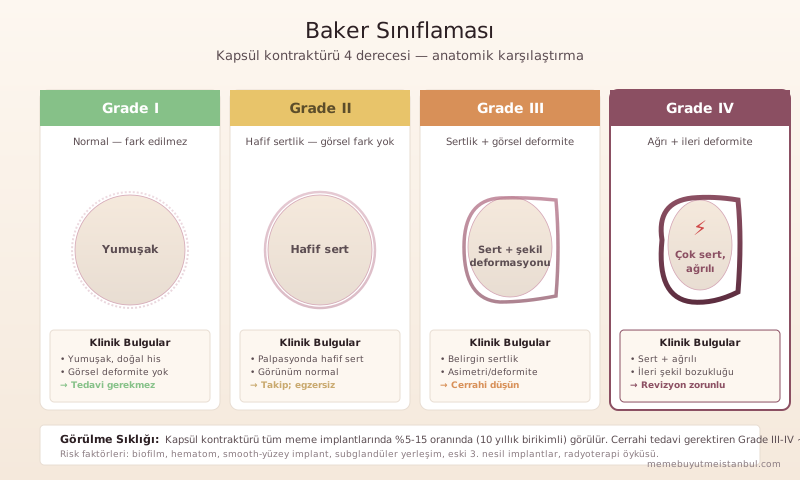
Baker sınıflaması — Grade I (normal) → Grade IV (ağrılı, ileri deformite)
| Reason | Type | Frequency | Urgency |
|---|---|---|---|
| Size change request | Aesthetic | ~30% | Not urgent |
| Capsular contracture (Baker III/IV) | Medical | ~15-20% | Moderate — early if symptomatic |
| Implant rupture / leak | Medical | ~10% | Moderate — silicone 3-6 mo, saline urgent |
| Implant malposition (drift) | Medical/Aesthetic | ~8% | As aesthetics warrant |
| Age-related sagging (secondary ptosis) | Aesthetic | ~8% | Patient preference |
| Rippling / visible edges | Aesthetic | ~6% | Aesthetic preference |
| Symmastia (breasts merging) | Medical | ~2% | Surgical correction needed |
| Double-bubble deformity | Aesthetic/Medical | ~3% | Surgical correction needed |
| BIA-ALCL / lymphoma suspicion | Medical (urgent) | <0.1% | Urgent — total capsulectomy |
| Implant removal decision | Patient choice | ~5% | Not urgent |
1. Size change (most common reason)
2-10 years after primary surgery, some patients want a different size:
- Want smaller: Back pain, "balloon" appearance, lifestyle change (returning to athletic activity, post-pregnancy).
- Want larger: Played it "too safe" first time; now want a more visible result. A common "going for it now" feeling.
- Profile change: Same cc, different profile — fuller upper-pole.
2. Capsular contracture (most common medical reason)
A natural fibrous capsule forms around every implant — this is a normal protective mechanism. In some patients, this capsule abnormally thickens and tightens.
Baker grading
| Grade | Finding | Approach |
|---|---|---|
| Baker I | Capsule not palpable, visually normal | No intervention needed |
| Baker II | Mild palpable firmness, visually normal | Monitor; conservative treatment |
| Baker III | Firmness + visible deformation | Surgery (capsulotomy or capsulectomy) |
| Baker IV | Firmness + deformation + pain | Surgery mandatory |
Treatment options
- Capsulotomy: Surgical loosening (incision) of the capsule without removal. For mild cases.
- Partial capsulectomy: Removal of part of the capsule.
- Total / en-bloc capsulectomy: Complete removal of the entire capsule. Standard approach.
- Implant exchange: Same session new implant + acellular dermal matrix (ADM) support.
- Pocket exchange: Switching subglandular to submuscular (or vice versa) reduces recurrence risk.
3. Implant rupture
Modern silicone implants have ~1% annual rupture rate; ~10% cumulative at 10 years. Symptoms and diagnosis:
Silicone rupture
- Usually asymptomatic (cohesive gel doesn't migrate)
- Detected by MRI: "linguine sign" — wavy lines within the capsule
- FDA recommendation: silicone implant carriers should have follow-up MRI every 2-3 years from year 5-6
Saline rupture
- Obvious: Rapid unilateral size loss (over hours-days)
- Saline absorbed safely
- Urgent — physically uncomfortable, cosmetic distortion
4. Implant malposition
Implants can drift in 4 directions over time:
- Bottoming-out: Implant drops below the fold. Nipple appears too high.
- Lateral drift: Implants splay sideways when lying down.
- Symmastia: Two implants merge in the middle ("uniboob" appearance).
- High-riding implant: "Drop and fluff" doesn't complete — still high after 6 months.
Treatment: capsulorrhaphy (capsule suturing), internal mesh / ADM reinforcement, or pocket change if needed.
5-7. Aesthetic complaints — Rippling, Sagging, Double-bubble
These can appear 1-5 years post-op:
- Rippling: Implant edges visible/palpable through skin. Common in thin tissue. Treatment: fat-grafting fill, switch to more cohesive implant, move from subglandular to submuscular.
- Secondary sagging: No sagging at first surgery, but nipple has descended below fold over years. Pregnancy, weight changes, aging. Treatment: implant exchange + mastopexy.
- Double-bubble: When implant sits at old fold while a new fold develops. Patient sees two horizontal lines while standing. Treatment: surgical correction.
How revision differs from primary surgery
| Feature | Primary surgery | Revision surgery |
|---|---|---|
| Duration | 1-2 hours | 2-4 hours (with capsulectomy) |
| Anaesthesia | General | General |
| Scar | New scar | Often via existing scar |
| Recovery | 4-6 weeks | 6-8 weeks (more aggressive) |
| Complication risk | ~1-3% | ~3-7% (higher) |
| Cost | Baseline | Baseline x 1.2-1.5 (depending on complexity) |
| Satisfaction rate | ~95% | ~80-85% |
Revision satisfaction is lower than primary because expectations may be higher and tissue is already affected. With proper indication, however, satisfaction remains good.
Decision checklist before revision
- Gather your primary surgery records: Implant passport, brand, model, placement type (subglandular/submuscular), date.
- Confirm results have stabilized: "Drop and fluff" takes 6 months; final result at 1 year. Revision before 12 months rarely advised.
- Same surgeon or different? If unhappy with primary outcome, second opinion is reasonable.
- Medical or aesthetic reason? Medical is priority; aesthetic should be patiently planned.
- Budget and recovery time: Revision is more expensive and longer than primary.
When to avoid revision
- Primary surgery hasn't reached 12 months (results haven't settled)
- Pregnancy plan within 2 years (results will change again)
- Untreated medical conditions (uncontrolled hypertension, diabetes, etc.)
- Just because "not quite right" without objective findings
- Surgeon team without revision experience — revision needs advanced skill