Breast augmentation: personalized planning
Breast augmentation is a plastic surgery procedure where silicone implants are used to enhance breast volume and shape. Dr. Erdal performs personalized planning for every patient — implant brand, shape, profile, placement, and incision choice are decided after thorough consultation, not from a "standard package."
Important: Breast augmentation is not a one-size-fits-all procedure. Rather than offering "standard packages," we conduct anatomical measurements, evaluate expectations, lifestyle, and health status to create individualized plans. The decision is made together during in-person consultation, not selected from a website.
Who is a candidate?
Suitable candidates for breast augmentation include:
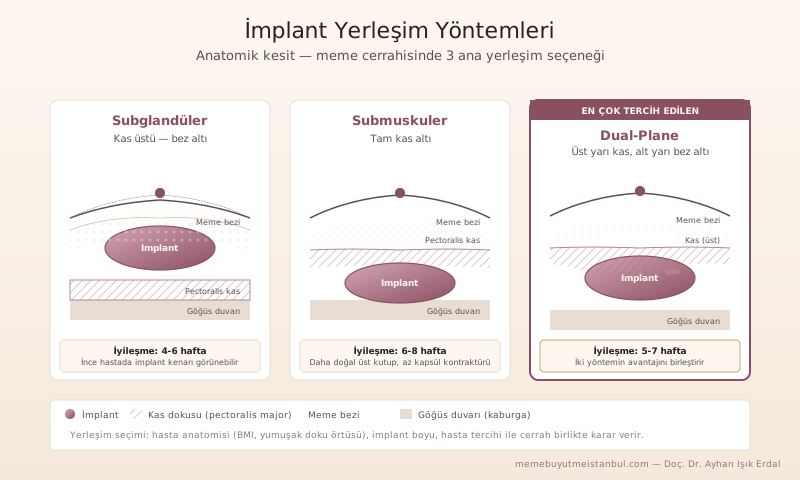
Three main placement methods — anatomical comparison
- Insufficient natural breast development — small breast tissue, asymmetry, developmental issues
- Post-pregnancy and breastfeeding — volume loss, "deflated" appearance
- Post-significant weight loss — reduced breast tissue, loss of fullness
- Age-related volume loss — natural decrease in tissue density
- Breast asymmetry — significant size or shape difference
- Post-mastectomy reconstruction — breast cancer survivors
Surgery technique
Pre-operative planning
Anatomical measurements are taken: breast base width, chest wall structure, skin elasticity, existing tissue volume. Patient height-weight ratio, shoulder width, activity level, and aesthetic goals are evaluated. The balance between desired and anatomically feasible is established collaboratively.
Anesthesia
Performed under general anesthesia in fully-equipped hospital with board-certified anesthesiologist. 1 night hospital observation is standard.
Incision selection
| Incision | Advantages | Limitations |
|---|---|---|
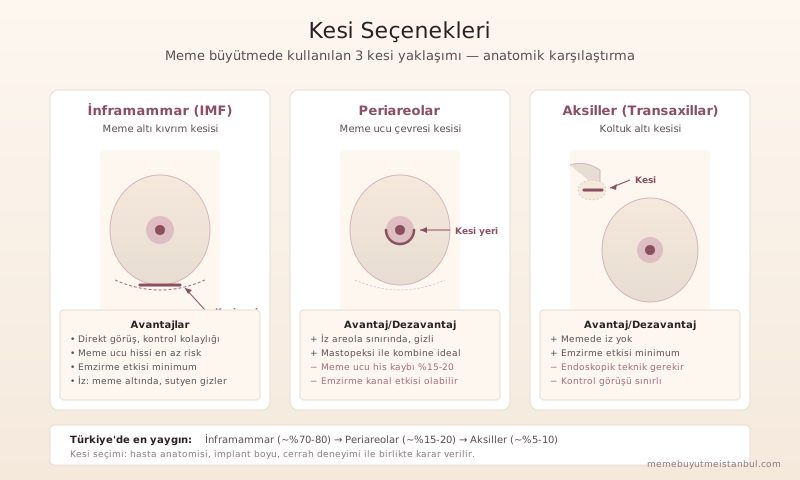
| Inframammary (under-breast crease) — most common | Direct access, precise placement, hidden in natural fold, minimal breastfeeding impact | Visible scar without bra (fades within 1 year) |
| Periareolar (around nipple) | Scar at areola border, combined with lift possible | Slight risk of milk duct damage, more visible in fair-skinned patients |
| Transaxillary (armpit) | No scar on breast, hidden in armpit fold | Limited visibility, not suitable for anatomical implants, harder asymmetry correction |
Implant placement
| Placement | Advantages | Disadvantages |
|---|---|---|
| Subpectoral (under muscle) | More natural appearance, less palpable, lower capsular contracture risk, easier mammography | Initial more painful, animation deformity in muscle activation |
| Subglandular (over muscle) | Faster recovery, less post-op pain, no animation distortion | Edge palpable in thin patients, higher capsular contracture risk |
| Dual-plane (combined) | Combines advantages: upper sub-muscular, lower sub-glandular | More complex surgical technique |
Implant options
Premium brands available: Motiva (Costa Rica - Q-Inside safety chip, nano-surface, Ergonomix), Mentor (USA - FDA-approved MemoryGel, longest clinical track record), Polytech (Germany - Microthane polyurethane, B-Lite lightweight), Allergan Natrelle INSPIRA (USA), and others. Selection based on patient anatomy, preferences, and budget. Detailed comparison on implants page.
Risks and complications
- Capsular contracture: 2-5% with modern textured/nano-surface implants. Treatment: capsulotomy or implant exchange.
- Hematoma / bleeding: ~1%, may require drainage.
- Infection: <1% with antibiotic prophylaxis and sterile surgical conditions.
- Nipple sensation changes: Temporary numbness common (30-40%), permanent change rare (2-5%).
- Implant rotation/displacement: Rare with anatomical implants on textured surface.
- Asymmetry: Mild asymmetry normal; significant cases may require revision.
- Implant rupture: 1 in 100,000 with modern cohesive gel implants — gel doesn't leak even if shell breaks.
- BIA-ALCL: Rare lymphoma, ~1 in 300,000 across all implant types. Pre-Biocell macrotextured implants had higher risk; modern nano-surface and microtextured implants minimize this.
Frequently asked questions
How long does the breast augmentation surgery take?
Standard breast augmentation takes 1.5-2 hours. Combined with breast lift (mastopexy-augmentation): 3-4 hours. Performed under general anesthesia in fully-equipped hospital with experienced anesthesiologist. Usually 1 night hospital observation followed by discharge.
What incision options are available?
Three main options: (1) Inframammary (under-breast crease) — most common, direct access, scar hidden in fold. (2) Periareolar (around nipple) — scar at areola border, can be combined with lift. (3) Transaxillary (armpit) — no scar on breast but limited visibility, not suitable for anatomical implants. Choice based on anatomy and preferences.
Where is the implant placed - over or under the muscle?
Sub-muscular (under chest muscle): more natural look in thin patients, less visible implant edge, lower capsular contracture risk, easier mammography. Sub-glandular (over muscle): faster recovery, less initial pain, no muscle animation distortion. Dual-plane (combined): blends advantages. Decided in consultation based on tissue thickness and lifestyle.
How is implant size determined?
Through anatomical measurements (breast width, chest wall, existing tissue), patient lifestyle assessment, and trial sizers in special bras. Turkish patients typically choose 295-470cc. Decision is collaborative — your goals balanced with anatomical feasibility. "Bigger is better" approach is avoided.
What are the main risks?
Capsular contracture (2-5% with modern implants), hematoma (1%), infection (<1%), nipple sensation changes (usually temporary, return in 6-12 months), implant rotation (rare with anatomical), asymmetry, BIA-ALCL (very rare, ~1 in 300,000). Modern surgical protocols and implant selection minimize these risks.
When can I return to work?
Desk jobs: 5-7 days. Light physical work: 10-14 days. Heavy physical work: 3-4 weeks. Most patients return to most daily activities within a week with arm movement restrictions for 2-3 weeks.
Will I be able to breastfeed after?
Yes, most patients can breastfeed after breast augmentation. Inframammary and transaxillary incisions preserve milk ducts well. Periareolar incisions carry slight risk of duct damage. If breastfeeding is planned, this is discussed in consultation for incision choice.
What is the implant lifespan?
Modern silicone implants (Motiva, Mentor 6th gen, Polytech) come with lifetime warranty. The "10-year replacement" rule is outdated. Implants don't need replacement unless there is leakage, capsular contracture, or patient preference change. Yearly follow-up is standard.