Of all complications associated with breast implants, capsular contracture is the one patients ask about most. It's also the most misunderstood. This article explains what capsular contracture really is, the modern understanding of why it happens, evidence-based prevention strategies, and treatment options when it does occur.
What is the capsule?
When any foreign object is placed inside the body, the immune system responds by forming a thin layer of fibrous tissue around it. This is not pathology — it's a normal protective reaction. The capsule that forms around a breast implant is similar to the capsule that forms around a pacemaker, joint replacement, or any other implanted medical device.
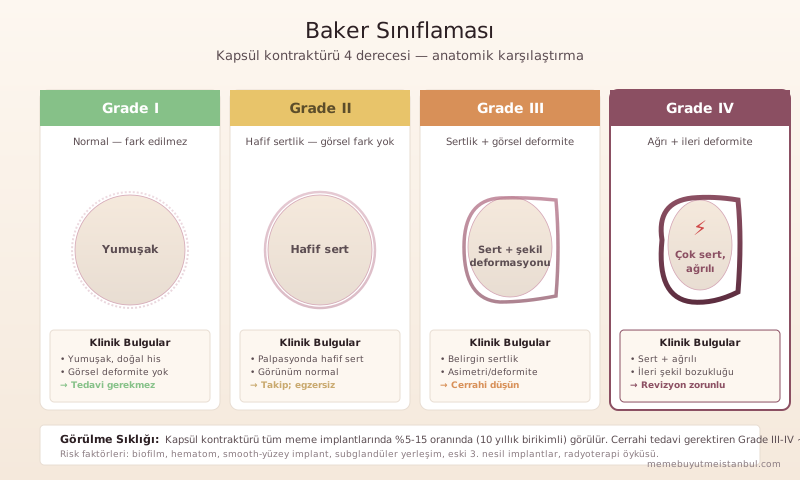
Baker sınıflaması — Grade I (normal) → Grade IV (ağrılı, ileri deformite)
In 85–95% of patients, the capsule remains thin, soft, and unnoticeable. The breast feels natural, moves naturally, and there is no clinical issue.
What is capsular contracture?
In a minority of patients, the capsule thickens and contracts (shrinks). As it tightens around the implant, it can:
- Make the breast feel firm to the touch
- Change the visible shape (rounder, "ball-like")
- Cause discomfort or pain in advanced cases
- Distort the implant position
Baker classification
Plastic surgeons grade capsular contracture using the Baker classification:
| Grade | Description | Action |
|---|---|---|
| I | Soft, natural appearance and feel | None — this is normal |
| II | Slightly firm but appearance still normal | Observation, possible massage |
| III | Firm, visible distortion of breast shape | Revision surgery generally indicated |
| IV | Hard, painful, severely distorted | Revision surgery indicated |
How common is it?
Modern published data:
- 5–10% lifetime incidence with cohesive silicone gel implants in submuscular placement
- 10–15% with subglandular placement
- Higher rates with macro-textured implants (Allergan BIOCELL, recalled in many countries)
- Higher rates after revision surgery (15–20%)
- Lower rates with modern smooth and nano-textured implants (Motiva SmoothSilk, Mentor MemoryGel smooth)
Most cases occur within the first 2 years post-op. Late contracture (5+ years out) is uncommon and often associated with subclinical infection or implant rupture.
Why does it happen?
The exact cause is multifactorial. Current evidence supports:
1. Subclinical bacterial biofilm
The leading hypothesis. Bacteria (often skin commensals like Staphylococcus epidermidis) form a biofilm on the implant surface during surgery. The biofilm is not symptomatic infection — it doesn't cause fever or pus — but it triggers a chronic low-grade inflammatory response that drives capsular thickening over months to years.
2. Hematoma or seroma
Collections of blood or serum around the implant after surgery promote capsular fibrosis. Meticulous hemostasis during surgery and avoidance of seroma drains capsular contracture risk.
3. Implant surface and content
Macro-textured surfaces (Allergan BIOCELL, recalled) had higher rates. Saline implants historically had lower rates than older non-cohesive silicone gel. Modern cohesive gel + smooth/nano-textured surface = lowest rates.
4. Genetic predisposition
Some patients have a tendency toward exuberant scar formation (keloids, hypertrophic scars). They may have higher capsular contracture rates.
Modern prevention strategies
Evidence-based intraoperative protocols can significantly reduce capsular contracture rates. Our practice follows the 14-point plan originally proposed by Adams and Mallucci:
- IV antibiotic prophylaxis within 60 minutes of incision
- Antibacterial skin preparation (chlorhexidine + alcohol)
- Sterile breast field — separate gowns, drapes, instruments after pocket creation
- Inframammary incision preferred over periareolar (lower bacterial load)
- Submuscular or dual-plane placement when appropriate
- Atraumatic dissection of pocket
- Meticulous hemostasis before implant placement
- Pocket irrigation with antibiotic solution (triple antibiotic + povidone-iodine)
- Implant introduction sleeve (Keller funnel) to minimize skin contact
- Nipple covers during implant insertion
- Glove change immediately before handling implant
- Minimal implant handling
- Layered closure with no implant exposure
- No routine drains (drains create a tract for bacteria)
Studies suggest this protocol can reduce contracture rates by 50% or more. We follow every point.
What patients can do
Beyond surgical technique, patients can reduce risk by:
- Choose a surgeon experienced in breast surgery — high-volume surgeons have lower complication rates
- Choose modern smooth or nano-textured implants — avoid macro-textured options
- Quit smoking for at least 4 weeks pre-op (impairs healing and microvasculature)
- Follow post-op instructions exactly — surgical bra, no heavy lifting, antibiotic compliance
- Address infections promptly — dental cleanings, urinary infections, etc. should be treated before they spread
- Annual surveillance with ultrasound or MRI to detect early changes
Treatment options when it occurs
Baker I–II (soft, mild firmness)
Observation. Capsular massage may help in some cases. No surgical intervention typically needed.
Baker III–IV (firm, distorted, painful)
Surgical revision is the gold standard. Options:
- Capsulotomy — surgical scoring of the capsule to release tension. Limited use; often leads to recurrence.
- Capsulectomy — complete removal of the capsule. More definitive. Combined with new implant placement, often in a different plane (e.g., subglandular → submuscular).
- Capsulectomy + acellular dermal matrix (ADM) — adding a sheet of ADM (e.g., AlloDerm) over the new implant reduces re-contracture in high-risk cases. More expensive but evidence-based for revisions.
- Implant exchange — replacing macro-textured implants with smooth or nano-textured types reduces recurrence.
- Explantation only — if you don't want a new implant, the existing one can be removed and capsule excised. Discuss expected aesthetic outcome carefully.
Adjuncts
Some surgeons use intraoperative adjuncts during revision:
- Acellular dermal matrix (ADM) — strongest evidence for prevention of recurrence
- Antibiotic irrigation — standard of care
- Capsular pocket exchange (e.g., subglandular → subpectoral)
- Singulair (montelukast) post-op — debated; some evidence for prevention but not universally accepted
Recurrence rates after revision
Unfortunately, capsular contracture is more likely to recur after a first episode. Published recurrence rates:
- Capsulotomy alone: 30–50% recurrence at 5 years
- Capsulectomy with implant exchange: 15–25%
- Capsulectomy with ADM: <10% in selected high-risk cases
This is why prevention via meticulous initial surgery is so important.
What about late-onset contracture (years after surgery)?
If contracture develops 5+ years out, suspect:
- Subclinical implant rupture (silent rupture causes inflammatory capsule thickening)
- Recent infection elsewhere (dental, urinary, skin) seeding the implant
- BIA-ALCL (rare but should be excluded with imaging and aspiration if any fluid is present)
Imaging (MRI/ultrasound) should always precede surgical revision in late-onset cases.
Bottom line
Capsular contracture remains the most common reason for revision surgery after breast augmentation. The good news: modern surgical technique, modern implants, and proper patient selection have dramatically reduced rates compared to the 1980s and 1990s. With a 14-point intraoperative protocol, smooth or nano-textured cohesive silicone gel implants, and submuscular/dual-plane placement, contracture rates can be kept below 5–7% at 10 years.
If contracture does occur, modern revision techniques are highly effective. Don't ignore symptoms — early diagnosis and treatment yield better outcomes than delayed intervention.
Further reading
- Implant types and surface texture explained
- Surgical procedure details
- Comprehensive FAQ on implant safety
About the author. Assoc. Prof. Dr. Ayhan Işık Erdal, MD, FACS, FEBOPRAS is a double board-certified plastic, reconstructive, and aesthetic surgeon based in Nişantaşı, Istanbul. He holds the T.C. Ministry of Health International Health Tourism Authorization Certificate (No: 2026034015...).
Disclaimer: This article is for educational purposes and does not replace personalized medical consultation. Always consult a board-certified plastic surgeon for individualized advice.