Recovery after breast augmentation runs along four parallel timelines: implant settling (drop & fluff), scar maturation, return to physical activity, and sensory (sensation) recovery. This guide walks you through each axis week-by-week and month-by-month — where one ends, another begins.
1. Drop & Fluff — implant settling process
In the early weeks after surgery, implants sit high on the chest wall — nipples lower, upper pole over-full, lower pole flat. This temporary state is called "high & tight." As the skin, pectoral muscle, and capsule pocket adapt, the implant gradually moves down (drop) and the lower pole fills out (fluff). Final shape takes 3-6 months (sometimes up to 12).
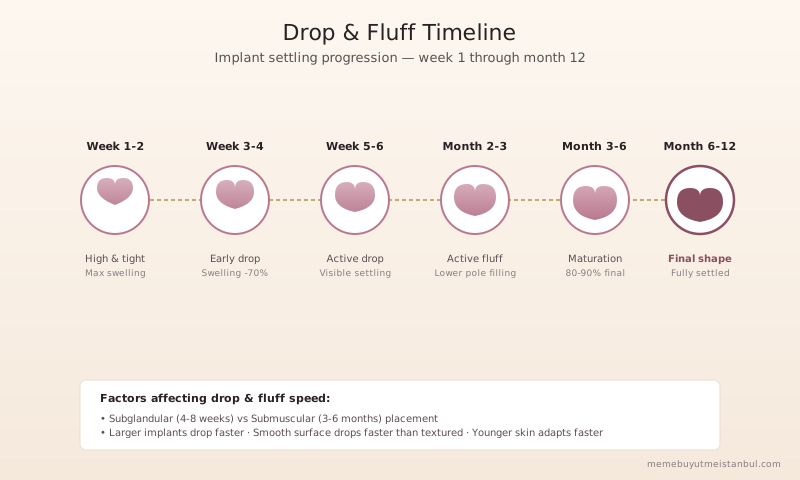
Drop & fluff: implant settles into natural position over 6-12 months
| Week | Appearance & Sensation | Drop & Fluff Stage |
|---|---|---|
| Week 1-2 | Maximum swelling. Implant high, upper pole full. Firm to touch. "Square" shape. | Not yet started |
| Week 3-4 | Swelling 70% reduced. Skin softening. Slight settling sensation possible. | Early drop |
| Week 5-6 | Implant visibly moves down. Asymmetric pace between sides is normal. | Active drop |
| Week 7-12 (Month 2-3) | Lower pole noticeably filling out. Upper pole calming. Shape becoming "natural." | Active fluff |
| Month 3-6 | 80-90% final shape. Full softness. Asymmetry (if any) resolving. | Maturation |
| Month 6-12 | Final shape. Breast movements completely normal. | Full settling |
Factors affecting drop & fluff speed
- Placement: Subglandular (above muscle) → faster (4-8 weeks). Submuscular (under muscle) → slower (3-6 months).
- Implant size: Larger implants drop faster due to gravity.
- Implant surface: Textured → slower (more tissue adhesion). Smooth → faster.
- Skin elasticity: Younger skin → faster. Older / postpartum skin → variable.
- Muscle tone: Athletic / tight-muscled women → slower drop (muscle takes longer to relax).
Important: don't panic in the first 2-4 weeks if "they look small" or "they sit high." This is a normal phase of recovery. Final assessment happens at month 6. Do not bra-shop until at least 6 weeks post-op — sizing will continue to change.
2. Scar maturation timeline
Surgical scar healing progresses through 4 phases and full maturation takes 12-24 months. So worrying about a "very red/visible scar" at months 1-3 is premature.
| Phase | Duration | Appearance | Care |
|---|---|---|---|
| Inflammation | 0-2 weeks | Red, slight swelling, possible scab | Wound care per surgeon, suture removal |
| Proliferation | 2 weeks - 2 months | Pink-purple, may be raised, itching | Silicone gel or silicone tape started (after week 4) |
| Remodelling | 2-12 months | Slowly lightening, flatter | Continue silicone, sun protection (SPF 50+) mandatory |
| Maturation | 12-24 months | Pale, mostly invisible | Care can end; final review at month 18 |
Scar care dos and don'ts
Do:
- From week 4: use silicone gel (e.g. Kelo-cote, Dermatix) or silicone tape (Mepiform, Scar-Gel) daily
- Protect the scar from sun while maturing (especially months 1-12): SPF 50+, covering clothing
- Gentle massage (from week 3-4 with surgeon's approval) — reduces adhesion
- Good nutrition, protein, vitamin C, zinc
Don't:
- Rub, scrub, or pound on the scar in the first 4 weeks
- Smoke — significantly impairs collagen synthesis; hypertrophic scar risk triples
- Use abrasive cosmetics (peels, acids) on the scar in first 6 months
- UV exposure (including tanning beds) for 12 months
3. Activity and sport timeline
Implant settling and tissue healing impose specific activity restrictions. Early overexertion → increased swelling, hematoma, capsular contracture risk.
| Activity | Earliest Start | Note |
|---|---|---|
| Light walking (in the home) | Day 1 | Mandatory for thrombosis prevention |
| Shower | Day 2-3 (with surgeon approval) | First week: no scrubbing of scar, lukewarm water |
| Driving | 2 weeks | Not while on painkillers; reflexes matter |
| Office work return | 1-2 weeks | Computer-based work earlier |
| Physical job (teacher, nurse) | 3-4 weeks | No heavy lifting |
| Light walking (outdoors) | 2 weeks | With sports bra |
| Light cardio (walking, elliptical) | 3-4 weeks | Heart rate under 130 |
| Yoga (light, lower body) | 4 weeks | No upper body, no arm pressure |
| Swimming (pool) | 4-6 weeks | Scar must be healed |
| Cycling (stationary or outdoor) | 4 weeks | Avoid leaning on elbows |
| Running (jogging) | 6-8 weeks | Tight sports bra required, small strides |
| Pilates / yoga (moderate) | 6-8 weeks | Upper body movements appropriate |
| Weight training (upper body) | 8-10 weeks | Start with light weights |
| CrossFit, HIIT, heavy lifting | 3 months | After full clearance |
| Sexual activity | 3-4 weeks | No upper body pressure |
| Air travel (short) | 1 week post | Thrombosis prevention measures |
| Long-haul flight (5+ hours) | 2 weeks post | Compression stockings, frequent movement |
4. Sleep position
| Week | Allowed Positions | Not Allowed |
|---|---|---|
| Week 1-2 | Supine, semi-elevated with pillow | Side, prone |
| Week 3-4 | Supine, brief side-rolls allowed | Prone |
| Week 5-6 | Side too (preferably supine) | Prone (caution until week 10) |
| Month 3+ | All positions free | — |
Supine sleep can be required for 6-8 weeks — to make this easier, use a U-pillow or travel pillow for back support. Side-sleeping with pillow propping can be tried from week 3-4.
5. Sensory recovery — nipple and skin sensitivity
Postoperatively, nipple and breast skin sensation changes. Because nerve endings may be temporarily disrupted, some areas may feel numb while others may be hypersensitive.
| Period | Expected State |
|---|---|
| Week 1-4 | Generalized numbness, weak touch sensation, pain or tenderness dominant |
| Month 1-3 | Sensitivity rises, "tingling," "electric" intermittent stimuli — signs of nerve recovery |
| Month 3-6 | Most sensitivity normalizes; nipple regains 85-90% of sensation |
| Month 6-12 | Final sensation state. 85% of patients regain full normal sensation. 10-15% have mild persistent numbness. |
Periareolar incision (around nipple) → highest sensation-loss risk (15-20% permanent). Inframammary incision (in the fold) → lowest risk (2-5% permanent). Axillary (armpit) → intermediate.
First-year follow-up schedule
| Visit | Time | What's Done |
|---|---|---|
| 1st visit | Day 5-7 | Wound assessment, suture care, drain removal (if any) |
| 2nd visit | 2 weeks | External suture removal, scar care guidance |
| 3rd visit | 1 month | Drop & fluff onset assessment, activity plan |
| 4th visit | 3 months | Scar review, symmetry check |
| 5th visit | 6 months | Final shape evaluation, photo documentation |
| 6th visit | 12 months | Annual follow-up, future planning |
For international patients, most follow-ups can be conducted via WhatsApp video consultation. Only the day 5-7 visit and possibly the 6-month visit require in-person examination.